Showing posts with label Multitenant. Show all posts

Wednesday, August 2, 2023

Linux Huge Pages and AUTO_ONLY option of Oracle 19c

HugePages is a feature integrated into the Linux kernel. A page is the basic unit of virtual memory, with the default page size being 4096 Bytes in the x86 architecture. Linux uses a mechanism in the CPU architecture called "Translation Lookaside Buffers" (TLB) to manage the mapping of virtual memory pages to actual physical memory addresses. So, when each time memory is accessed using the default page size, there is additional overhead as many TLB resources are consumed.


With the implementation of Huge Pages, we are grouping these small pages into a bigger chunk with consuming a single resource in TLB. Huge pages are of size 2MB (default) or 1GB (called as gigantic pages and can be configured). 

For Oracle Database, using HugePages reduces the operating system maintenance of page states and increases Translation Lookaside Buffer (TLB) hit ratio. 

Configuring Huge pages: 

There are a few conditions to be met before configuring huge pages. 

1. Linux kernel should support huge pages. 
2. Edit the memlock settings in /etc/security/limits.conf file. It is advisable to set the maximum locked memory limit to at least 90 percent of the current RAM when you enable HugePages memory. 
Make sure that you are running applications that requires Hugepages (if configured), as the locked memory can only be utilized by the application that requests them and they are not available for normal memory allocations. One advantage of using Hugepages is that the memory is pinned and will not be swapped out of memory providing better performance.

In my lab system, I have the memlock limits for oracle user set as below. Value is set in KB
oracle   hard   memlock    134217728
oracle   soft   memlock    134217728
The current settings can be verified by ulimit -l 
[oracle@linux-8 ~]$ ulimit -l
134217728
[oracle@linux-8 ~]$
3. Calculate the number of huge pages required. 
For Oracle database requirements, we can utilize the script provided by Oracle support via support note 401749.1
Script usage is as below. Make sure all the DBs are up and running before initiating the script as the calculation is done for all shared memory segments available when the script is run, no matter it is an Oracle RDBMS shared memory segment or not. 
SQL> sho parameter sga_max_size

NAME                                 TYPE        VALUE
------------------------------------ ----------- ------------------------------
sga_max_size                         big integer 4G
SQL> exit
Disconnected from Oracle Database 19c Enterprise Edition Release 19.0.0.0.0 - Production
Version 19.10.0.0.0
[oracle@linux-8 ~]$ ls -lrt huge*
-rwxr-xr-x. 1 oracle oinstall 3485 Aug  1 10:34 hugepages_settings.sh
[oracle@linux-8 ~]$ ./hugepages_settings.sh

This script is provided by Doc ID 401749.1 from My Oracle Support
(http://support.oracle.com) where it is intended to compute values for
the recommended HugePages/HugeTLB configuration for the current shared
memory segments on Oracle Linux. Before proceeding with the execution please note following:
 * For ASM instance, it needs to configure ASMM instead of AMM.
 * The 'pga_aggregate_target' is outside the SGA and
   you should accommodate this while calculating the overall size.
 * In case you changes the DB SGA size,
   as the new SGA will not fit in the previous HugePages configuration,
   it had better disable the whole HugePages,
   start the DB with new SGA size and run the script again.
And make sure that:
 * Oracle Database instance(s) are up and running
 * Oracle Database 11g Automatic Memory Management (AMM) is not setup
   (See Doc ID 749851.1)
 * The shared memory segments can be listed by command:
     # ipcs -m


Press Enter to proceed...

Recommended setting: vm.nr_hugepages = 2050
[oracle@linux-8 ~]$
[oracle@linux-8 ~]$
We can see the Recommended setting is to set vm.nr_hugepages = 2050 pages. This can be manually calculated by us if we know what exact memory we need for the oracle database SGA and other dependent applcations. 
In our case, I run only the Oracle database with sga_max_size of 4 GB. Default hugepage size is 2MB. So, to have 4GB memory of 2 MB page size we would need 4GB / 2MB = 4096 MB / 2 MB = 2048 pages + Minimum pages (here 1 page) + 1 = 2050 pages. 

If you have multiple DBs running in the system, we need to calculate the cumulative amount for all the DBs that needs to reserve hugepages. 

What if I don't set the memlock parameter in limits.conf file and try to start up the database? 

It's interesting we sometimes set the hugepages to the correct value as suggested by the Oracle provided script but miss to set the limits.conf file to mention which user can lock how much memory. In such cases, Oracle database would fail to start with the below error indicated in the alert log. 
**********************************************************************
2023-07-31T09:43:20.619135+05:30
Dump of system resources acquired for SHARED GLOBAL AREA (SGA)

2023-07-31T09:43:20.619242+05:30
 Per process system memlock (soft) limit = 64K
2023-07-31T09:43:20.619279+05:30
 Expected per process system memlock (soft) limit to lock
 instance MAX SHARED GLOBAL AREA (SGA) into memory: 4100M
2023-07-31T09:43:20.619346+05:30
 Available system pagesizes:
  4K, 2048K
2023-07-31T09:43:20.619412+05:30
 Supported system pagesize(s):
2023-07-31T09:43:20.619447+05:30
  PAGESIZE  AVAILABLE_PAGES  EXPECTED_PAGES  ALLOCATED_PAGES  ERROR(s)
2023-07-31T09:43:20.619510+05:30
     2048K                5            2050               0   ORA-27125
2023-07-31T09:43:20.619545+05:30
 Reason for not supporting certain system pagesizes:
2023-07-31T09:43:20.619603+05:30
  4K - Large pagesizes only
2023-07-31T09:43:20.619652+05:30
RECOMMENDATION:
2023-07-31T09:43:20.619688+05:30
 1. Configure system with expected number of pages for every
 supported system pagesize prior to the next instance restart operation.
2023-07-31T09:43:20.622629+05:30
 2. Increase per process memlock (soft) limit to at least 4100MB
 to lock 100% of SHARED GLOBAL AREA (SGA) pages into physical memory
2023-07-31T09:43:20.622708+05:30
**********************************************************************
2023-07-31T09:43:20.622896+05:30
Oradism deallocated 5 large pages of size 2097152 bytes.
2023-07-31T09:43:20.622933+05:30
SGA: Realm creation failed
2023-07-31T10:04:04.780997+05:30
Starting ORACLE instance (normal) (OS id: 38918)
2023-07-31T10:04:04.784579+05:30
************************************************************
Instance SGA_TARGET = 4096 MB and SGA_MAX_SIZE = 4096 MB
************************************************************
2023-07-31T10:04:04.784879+05:30
****************************************************
 Sys-V shared memory will be used for creating SGA
 ****************************************************
2023-07-31T10:04:04.787059+05:30
DISM started, OS id=39038
2023-07-31T10:04:08.928252+05:30
ERROR: Failed to get available system pages to allocate memory
2023-07-31T10:04:08.929435+05:30
**********************************************************************
..
..

Init parameter use_large_pages = ONLY

With Oracle database version 11.2.0.3 and above we have database parameter use_large_pages = ONLY (Default parameter value is TRUE) which would make the database start up to fail if the expected number of huge pages are not available in the system. 
SQL> sho parameter use_large_pages

NAME                                 TYPE        VALUE
------------------------------------ ----------- ------------------------------
use_large_pages                      string      TRUE
SQL> alter system set use_large_pages=ONLY scope=spfile;

System altered.

SQL>exit
Disconnected from Oracle Database 19c Enterprise Edition Release 19.0.0.0.0 - Production
Version 19.10.0.0.0
[oracle@linux-8 ~]$ grep Huge /proc/meminfo
AnonHugePages:         0 kB
ShmemHugePages:        0 kB
HugePages_Total:       0
HugePages_Free:        0
HugePages_Rsvd:        0
HugePages_Surp:        0
Hugepagesize:       2048 kB
Hugetlb:               0 kB
[oracle@linux-8 ~]$ 
We can see Hugepages is not configured (HugePages_Total : 0). Now, let me configure hugepages less than 2050 pages and try to startup the database. 
[oracle@linux-8 ~]$ vi /etc/sysctl.conf
[oracle@linux-8 ~]$ sudo vi /etc/sysctl.conf
[sudo] password for oracle:
[oracle@linux-8 ~]$
[oracle@linux-8 ~]$ cat /etc/sysctl.conf |grep huge
vm.nr_hugepages = 2000
[oracle@linux-8 ~]$ sudo sysctl -p
fs.file-max = 6815744
kernel.sem = 250 32000 100 128
kernel.shmmni = 4096
kernel.shmall = 1073741824
kernel.shmmax = 4398046511104
kernel.panic_on_oops = 1
net.core.rmem_default = 262144
net.core.rmem_max = 4194304
net.core.wmem_default = 262144
net.core.wmem_max = 1048576
net.ipv4.conf.all.rp_filter = 2
net.ipv4.conf.default.rp_filter = 2
fs.aio-max-nr = 1048576
net.ipv4.ip_local_port_range = 9000 65500
vm.nr_hugepages = 2000
[oracle@linux-8 ~]$ grep Huge /proc/meminfo
AnonHugePages:         0 kB
ShmemHugePages:        0 kB
HugePages_Total:    2000
HugePages_Free:     2000
HugePages_Rsvd:        0
HugePages_Surp:        0
Hugepagesize:       2048 kB
Hugetlb:         4096000 kB
[oracle@linux-8 ~]$
[oracle@linux-8 ~]$ sqlplus / as sysdba

SQL*Plus: Release 19.0.0.0.0 - Production on Tue Aug 1 11:22:22 2023
Version 19.10.0.0.0

Copyright (c) 1982, 2019, Oracle.  All rights reserved.


Connected to:
Oracle Database 19c Enterprise Edition Release 19.0.0.0.0 - Production
Version 19.10.0.0.0

SQL> startup force
ORA-27106: system pages not available to allocate memory
Additional information: 6183
Additional information: 1
SQL>
Alert log will register the below  
Starting ORACLE instance (normal) (OS id: 70058)
2023-08-01T11:22:35.736716+05:30
************************************************************
Instance SGA_TARGET = 4096 MB and SGA_MAX_SIZE = 4096 MB
************************************************************
2023-08-01T11:22:35.736896+05:30
****************************************************
 Sys-V shared memory will be used for creating SGA
 ****************************************************
2023-08-01T11:22:35.737250+05:30
ERROR: Failed to get available system pages to allocate memory
2023-08-01T11:22:35.737286+05:30
**********************************************************************
2023-08-01T11:22:35.737319+05:30
Dump of system resources acquired for SHARED GLOBAL AREA (SGA)

2023-08-01T11:22:35.737376+05:30
 Per process system memlock (soft) limit = 128G
2023-08-01T11:22:35.737410+05:30
 Expected per process system memlock (soft) limit to lock
 instance MAX SHARED GLOBAL AREA (SGA) into memory: 4100M
2023-08-01T11:22:35.737473+05:30
 Available system pagesizes:
  4K, 2048K
2023-08-01T11:22:35.737535+05:30
 Supported system pagesize(s):
2023-08-01T11:22:35.737572+05:30
  PAGESIZE  AVAILABLE_PAGES  EXPECTED_PAGES  ALLOCATED_PAGES  ERROR(s)
2023-08-01T11:22:35.737630+05:30
     2048K             2000            2050            1997   ORA-27102
2023-08-01T11:22:35.737663+05:30
 Reason for not supporting certain system pagesizes:
2023-08-01T11:22:35.737696+05:30
  4K - Large pagesizes only
2023-08-01T11:22:35.737728+05:30
RECOMMENDATION:
2023-08-01T11:22:35.737760+05:30
 1. Configure system with expected number of pages for every
 supported system pagesize prior to the next instance restart operation.
2023-08-01T11:22:35.741864+05:30
**********************************************************************
2023-08-01T11:22:35.741932+05:30
SGA: Realm creation failed
..
If I increase the huge pages to 2050 and try to start the database, the database will start allocating the expected hugepages. 

Init parameter use_large_pages = AUTO_ONLY

Starting Oracle database version 19c, we have a new option for use_large_pages = AUTO_ONLY which is the default value for 19c databases running on Exadata systems and can be configured for on premise databases as well. 

By setting the value to AUTO_ONLY, Oracle will request Linux system automatically on how many numbers of pages are required to start the database and if the server can provision the pages, the database will be started. If the request cannot be provisioned, database will fail to start. 

For demo purpose, I'll reset the hugepages to 0 and set the value use_large_pages = AUTO_ONLY using the pfile and try to start the database. 
[oracle@linux-8 ~]$ sudo vi /etc/sysctl.conf
[sudo] password for oracle:
[oracle@linux-8 ~]$
[oracle@linux-8 ~]$ sudo sysctl -p
fs.file-max = 6815744
kernel.sem = 250 32000 100 128
kernel.shmmni = 4096
kernel.shmall = 1073741824
kernel.shmmax = 4398046511104
kernel.panic_on_oops = 1
net.core.rmem_default = 262144
net.core.rmem_max = 4194304
net.core.wmem_default = 262144
net.core.wmem_max = 1048576
net.ipv4.conf.all.rp_filter = 2
net.ipv4.conf.default.rp_filter = 2
fs.aio-max-nr = 1048576
net.ipv4.ip_local_port_range = 9000 65500
vm.nr_hugepages = 0
[oracle@linux-8 ~]$ grep Huge /proc/meminfo
AnonHugePages:         0 kB
ShmemHugePages:        0 kB
HugePages_Total:       0
HugePages_Free:        0
HugePages_Rsvd:        0
HugePages_Surp:        0
Hugepagesize:       2048 kB
Hugetlb:               0 kB
[oracle@linux-8 ~]$
[oracle@linux-8 ~]$ vi /oracle/db/db19/dbs/initcdb19.ora
[oracle@linux-8 ~]$ grep large_pages /oracle/db/db19/dbs/initcdb19.ora
*.use_large_pages='AUTO_ONLY'
[oracle@linux-8 ~]$ sqlplus / as sysdba

SQL*Plus: Release 19.0.0.0.0 - Production on Tue Aug 1 11:37:59 2023
Version 19.10.0.0.0

Copyright (c) 1982, 2019, Oracle.  All rights reserved.

Connected to an idle instance.

SQL> startup pfile=/oracle/db/db19/dbs/initcdb19.ora
ORACLE instance started.

Total System Global Area 4294963992 bytes
Fixed Size                  9143064 bytes
Variable Size            1056964608 bytes
Database Buffers         3221225472 bytes
Redo Buffers                7630848 bytes
Database mounted.
Database opened.
SQL> exit
Disconnected from Oracle Database 19c Enterprise Edition Release 19.0.0.0.0 - Production
Version 19.10.0.0.0
[oracle@linux-8 ~]$
[oracle@linux-8 ~]$ grep Huge /proc/meminfo
AnonHugePages:         0 kB
ShmemHugePages:        0 kB
HugePages_Total:    2050
HugePages_Free:        3
HugePages_Rsvd:        3
HugePages_Surp:        0
Hugepagesize:       2048 kB
Hugetlb:         4198400 kB
[oracle@linux-8 ~]$
You can see Oracle dynamically requested Linux to allocate 2050 pages and once the request is provisioned the database is started without us needing to configure the number of huge pages required. 

Now if I try to start another instance with 100 MB sga_max_size, if the system can provision the requested pages the database will start.  
[oracle@linux-8 ~]$ vi /oracle/db/db19/dbs/initlpdemo.ora
[oracle@linux-8 ~]$ cat /oracle/db/db19/dbs/initlpdemo.ora | grep 'sga_max\|use_large'
*.sga_max_size=100m
*.use_large_pages='AUTO_ONLY'
[oracle@linux-8 ~]$
[oracle@linux-8 ~]$ . oraenv
ORACLE_SID = [oracle] ? lpdemo
ORACLE_HOME = [/home/oracle] ? /oracle/db/db19
The Oracle base has been set to /oracle/db
[oracle@linux-8 ~]$ sqlplus / as sysdba

SQL*Plus: Release 19.0.0.0.0 - Production on Tue Aug 1 11:52:02 2023
Version 19.10.0.0.0

Copyright (c) 1982, 2019, Oracle.  All rights reserved.

Connected to an idle instance.

SQL> startup nomount pfile=/oracle/db/db19/dbs/initlpdemo.ora
ORACLE instance started.

Total System Global Area  322960856 bytes
Fixed Size                  8895960 bytes
Variable Size             239075328 bytes
Database Buffers           67108864 bytes
Redo Buffers                7880704 bytes
SQL> exit
Disconnected from Oracle Database 19c Enterprise Edition Release 19.0.0.0.0 - Production
Version 19.10.0.0.0
[oracle@linux-8 ~]$ 
[oracle@linux-8 ~]$ grep Huge /proc/meminfo
AnonHugePages:         0 kB
ShmemHugePages:        0 kB
HugePages_Total:    2206
HugePages_Free:        6
HugePages_Rsvd:        6
HugePages_Surp:        0
Hugepagesize:       2048 kB
Hugetlb:         4517888 kB
[oracle@linux-8 ~]$
It is not always guaranteed that the requested hugepages will be provisioned by Linux. If the system cannot allocate the required hugepages, database instance creation will fail registering insufficient number of hugepages in the alert log. 
2023-08-01T11:59:33.682674+05:30
 Available system pagesizes:
  4K, 2048K
2023-08-01T11:59:33.682755+05:30
 Supported system pagesize(s):
2023-08-01T11:59:33.682796+05:30
  PAGESIZE  AVAILABLE_PAGES  EXPECTED_PAGES  ALLOCATED_PAGES  ERROR(s)
2023-08-01T11:59:33.682866+05:30
     2048K              151             156             151   ORA-27102
2023-08-01T11:59:33.682899+05:30
 Reason for not supporting certain system pagesizes:
2023-08-01T11:59:33.682932+05:30
  4K - Large pagesizes only
2023-08-01T11:59:33.682964+05:30
RECOMMENDATION:
2023-08-01T11:59:33.683022+05:30
 1. Configure system with expected number of pages for every
 supported system pagesize prior to the next instance restart operation.
2023-08-01T11:59:33.697313+05:30
**********************************************************************
2023-08-01T11:59:33.697997+05:30
Oradism deallocated 151 large pages of size 2097152 bytes.
2023-08-01T11:59:33.698067+05:30
SGA: Realm creation failed

Advantages and implementations

Now as we understand how use_large_pages = AUTO_ONLY works, we need to understand where this setting can be implemented and what are the advantages

1. This setting doesn't require the prior calculation of no. of hugepages to be made with the scripts. 
2. When we add additional instances and if we intend to run those instances using hugepages, no changes necessary to system parameters are needed as the calculation and allocation of huge pages is dynamic. 
3. Can be used in development or test systems where instances are added and removed frequently. 
4. Dedicated single production database (though not recommended as a change in sga_max_size will have impact on how many pages are used and locked which might cause memory starvation if over provisioned by mistake). 

Quick note: Though the allocation of hugepages is dynamic, the pages are not released after the database is shut down and is shown under Hugepages_Free. This has an impact as this memory can't be used for normal memory allocation and is a waste of resource until next reboot. 

References:

Oracle Linux: Shell Script to Calculate Values Recommended Linux HugePages / HugeTLB Configuration (Doc ID 401749.1)


Happy Huge Paging...!!!
Saturday, June 24, 2023

Using Real time SQL Monitor in command line!

Query optimization or tuning is an interesting subject. Sometimes we would get complaints from application folks that their query is running slow in the timelines of running 4 hours against 1 or 2 hrs normal execution. During these times, we can't wait for the query to run to its completion only to see the query didn't run as expected. 

How can we find whether the query is running as expected? One of the simple ways is to run the explain plan to see whether the plan has changed from the existing one and is the join methods and filters are applied as expected and also whether the cost of the operation is reduced. But the problem here is Oracle can totally predict a wrong plan (due to missing stats for example) or with the adaptive plans can change its plan during run time as well. 

In order to know the details of the query execution we need to wait until the query completes. This is not welcome in all the situations as DBA can't wait for the query execution to complete before they decide on next course of investigation plan.

We can use DBMS_XPLAN.display_cursor or ?/rdbms/admin/utlxpls.sql or similar tools to get the explain plan of the query but for these to work to give the detailed statistics, the query should be run to its completion. Waiting for 2 or 3 hours just to check the execution details of the query seems not fun. 

Starting version 11g, Oracle introduced a feature called Real time SQL Monitoring. This is such a cool and useful feature where the stats can be seen in real time even the query is currently running. 

Requirements to use Real time SQL Monitor: 

  1. Diagnostics and Tuning Pack license.
  2. STATISTICS_LEVEL= 'TYPICAL' or 'ALL'
Methods to run Real time SQL Monitor: 
  1. Oracle Enterprise Manager
  2. SQL Developer
  3. Command line. 
Conditions where SQL is monitored by default: 
  1. When the SQL has consumed at least five seconds of the CPU or I/O time in a single execution
  2. When the SQL execute in parallel
  3. When the SQL has /*+ monitor */ hint

In this post, we are going to look into how to run Real time SQL Monitor using command line and view its results which will be useful to analyze the query execution

There are 2 packages via which sql can be monitored in real time. 

DBMS_SQLTUNE
DBMS_SQL_MONITOR

DBMS_SQLTUNE is a package that deals with tuning SQL on demand and is available from Oracle 11g onwards. The package deals with SQL profiles, creating and executing tuning tasks, tracing SQL, monitor SQL and reporting monitored SQL, etc.. We will look how to report real time SQL monitor using DBMS_SQLTUNE with an example. 

To report real time SQL, all we need is the sql_id along with the report type. By default, the report will be of text format but we have an option to get the report in nice and tidy html format. If the report needs to be generated only for a specific sql_plan_hash_value, then the value for this parameter can be provided. 

Usage example: 

DBMS_SQLTUNE

I'm now running a query with /*+monitor */ hint as this query takes less than 5 sec but I need to check the path the query has taken. 
Once the query has run or if it is a long running query we can check the v$sql_monitor view to see if the query has been captured for real time monitoring. We can then use the dbms_sqltune.report_sql_monitor procedure to report the real time statistics of the query. 
SQL> alter session set container=odb1;

Session altered.

SQL> set lines 200
SQL> select /*+ monitor */ * from oe.order_items join oe.orders on oe.order_items.order_id=oe.orders.order_id;

  ORDER_ID LINE_ITEM_ID PRODUCT_ID UNIT_PRICE   QUANTITY   ORDER_ID ORDER_DATE                     ORDER_MO CUSTOMER_ID ORDER_STATUS ORDER_TOTAL SALES_REP_ID PROMOTION_ID
---------- ------------ ---------- ---------- ---------- ---------- ------------------------------ -------- ----------- ------------ ----------- ------------ ------------
      2354            1       3106         48         61       2354 14-JUL-08 05.18.23.234567 PM   direct           104            0       46257          155
      2354            2       3114       96.8         43       2354 14-JUL-08 05.18.23.234567 PM   direct           104            0       46257          155
      2354            3       3123         79         47       2354 14-JUL-08 05.18.23.234567 PM   direct           104            0       46257          155
      2354            4       3129         41         47       2354 14-JUL-08 05.18.23.234567 PM   direct           104            0       46257          155
      2354            5       3139         21         48       2354 14-JUL-08 05.18.23.234567 PM   direct           104            0       46257          155
...
...
...
      2458            2       3123         79        112       2458 16-AUG-07 02.34.12.234359 PM   direct           101            0     78279.6          153
      2458            3       3127      488.4        114       2458 16-AUG-07 02.34.12.234359 PM   direct           101            0     78279.6          153
      2458            4       3134         17        115       2458 16-AUG-07 02.34.12.234359 PM   direct           101            0     78279.6          153

665 rows selected.

SQL>
SQL> SET LINESIZE 300
SQL> COLUMN sql_text FORMAT A100
SQL> SELECT sql_id, status, sql_text FROM v$sql_monitor where sql_text like '%monitor%';

SQL_ID        STATUS              SQL_TEXT
------------- ------------------- ----------------------------------------------------------------------------------------------------
abf24z16pukw9 DONE (ALL ROWS)     select /*+ monitor */ * from oe.order_items join oe.orders on oe.order_items.order_id=oe.orders.orde
                                  r_id

SQL> SET LONG 1000000
SQL> SET FEEDBACK OFF head off
SQL> spool monitor_sql.html
SQL> SELECT DBMS_SQLTUNE.report_sql_monitor(sql_id =>'abf24z16pukw9',type=> 'HTML') AS report FROM dual;


o/p will contain lots of html contents
as the report is generated as html.. 
...
...
...


SQL> spool off
SQL> 
We now have the report generated by name monitor_sql.html. We can view the report to see the real time execution plan statistics of the query. 


Since the query is now completed, we see the complete execution plan statistics and the completion of the query is 100%. This report is very useful when there is a long running query and if we need to investigate what's causing slowness. 

To showcase this, I just inserted 3 fold data into sales table but didn't gather statistics and ran a query without any filters. 
The first report generated shows below. 


The query runs for a very long time and the subsequent reports shows the progress of the query until it completes. Here, we can find that the query expected 919k rows from the sales table but the actual rows returned is 4M which is 4 folds higher than the expected value and hence we can easily say that the statistics is not proper for the table. 


DBMS_SQL_MONITOR

DBMS_SQL_MONITOR package provides information about Real-Time SQL Monitoring and Real-Time Database Operation Monitoring whereas DBMS_SQLTUNE is a comprehensive package consisting of all SQL related tuning capabilities and is an interface for SQL tuning on demand. 
Generating real time sql monitoring report using DBMS_SQL_MONITOR is similar to using DBMS_SQLTUNE and the report is also generated same as this. 
DBMS_SQL_MONITOR is introduced in 12c and we can now monitor SQL and PL/SQL calls containing SQL as well. 

Usage will be as below 

SQL> SET LONG 1000000
SQL> SET FEEDBACK OFF head off
SQL> spool monitor_sql.html
SQL> SELECT DBMS_SQL_MONITOR.report_sql_monitor(sql_id =>'1uhbtu4azdyqh',type=> 'HTML') AS report FROM dual;

SQL> spool off
SQL> 
Report generated will be similar to the one we saw before using DBMS_SQLTUNE with just the package name change. 


While SQL monitoring report of type => HTML gives a well formatted html report to analyze the query execution, we can generate ACTIVE report which would provide much better and additional information such as optimizer environment, parallel activity section for parallel queries, etc. Active report is my favorite go to tool for query tuning. 

So how would you generate the SQL monitor ACTIVE report? Use type => ACTIVE in the REPORT_SQL_MONITOR function as below. 
SQL> SET LONG 1000000  LONGCHUNKSIZE 1000000  LINESIZE 1000  PAGESIZE 0  TRIM ON  TRIMSPOOL ON  ECHO OFF  FEEDBACK OFF
SQL> spool monitor_sql.html
SQL> SELECT DBMS_SQLTUNE.report_sql_monitor(sql_id =>'abf24z16pukw9',type=> 'ACTIVE') AS report FROM dual;
...
...
...

SQL> spool off
The report generated will be like below. 


We can see that the report is kind of interactive where we can change the execution plan to graphical mode if one wishes to understand better and we can toggle between various options to check the complete picture of where the query is executed like the Optimizer Environment, etc. Timeline section will keep updating if we generate the report frequently while the query is running. 

When the graphical mode is toggled, we get the easily understandable view of the execution plan


Hope this helps investigate the real time sql using command line. 

References: 

DBMS_SQLTUNE (oracle.com)
DBMS_SQL_MONITOR (oracle.com)
Monitoring SQL Statements with Real-Time SQL Monitoring (Doc ID 1380492.1)

Happy Tuning...!!! 

P.S: I'm not able to generate the real time reports on the Database version 23 Free and have raised a community discussion. Let's wait to hear on this.. 

Update: 
The community discussion has been answered by SQL Developer fame Jeff Smith. 
DIAGNOSTIC+TUNING pack is by default disabled and we need to enable it to generate the reports. 

Also, I have added the section of how to generate Active SQL monitor reports. 

Friday, April 7, 2023

Oracle Transparent Application Continuity (TAC) - Part 2

I have started a transaction in my bank account and money got deducted but the screen doesn't get me the confirmation of the transaction and ended with a time out error. There could be multiple reason and one of the reason being one of the node on which the session was working crashed.

How many of you encountered this situation?

Now, if the bank/application once recovered and connected to the database (on a surviving node) and there is no details of the previous transaction available to the new session just got connected. What happens to the data? Would it get committed?

If the application tries to run the same previous transaction, money might be deducted twice. If the application doesn't retry, your transaction might not be carried out and you might miss some important last date of bill payment

So, how does Oracle handles this? 

In my last post, I explained about how Transparent Application Failover works and how it would be a great advantage for applications that mostly reads the database. 

As a continuation of that post, we will see about the Transparent Application Continuity on what is it and how does it benefit applications utilizing this feature of Oracle. 

Okay! We should know about Transaction Guard and Application Continuity before we dive into Transparent Application Continuity. Let's see them in brief to understand what they are.. 

Transaction Guard:

Transaction Guard provides a generic tool for applications to use for at-most-once execution in case of planned and unplanned outages. Applications use the logical transaction ID to determine the outcome of the last transaction open in a database session following an outage.
If you take the bank example, if the commit already happened and if application tries to replay the execution without knowing the status of the last transaction, this might lead to logical corruption of the data by committing duplicate transaction.

Benefits of Transaction Guard includes preserving the commit outcome, ensuring known outcome of every transaction and it can be used to provide at-most-once transaction execution

Let's see the illustration below


DB node crashed when: 
Session 1 committed the transaction but acknowledgement is not yet returned to application. Application now don't know status of the previous transaction
Session 2 is idle, hence no impact to the session even this session goes off
Session 3 issues the commit but before the commit is received in the database

So without transaction guard, session 1 and 3 won't be able to proceed further since they don't know the status of the previous transaction. Client is left unknown whether transaction is committed. Logical corruption is possible if application try to rerun the transaction and missing data is possible if the transaction is not retried. This is why it is difficult to failover DML when a failure occurs on a specific node as the application fails to recognize that the last submission has committed, or shall commit sometime soon, or has not run to completion. 

How do we resolve this mystery? What if we store the commit outcome in the database itself before letting the application/client know? This is what was done by introducing LTXID in Oracle database version 12.1.0.1. 

Durability of commit is saved as a Logical Transaction Identifier (LTXID) at commit for all supported transaction types and is unique for each transaction. Applications can use this LTXID to determine the commit status. LTXID is persisted on commit and reused following a rollback. The transaction history table maintains the mapping of LTXIDs to database transaction. LTXID_TRANS table is created to store the LTXIDs and is not accessible by non-DBA user. 
Hope it is clear what exactly is transaction guard provides us. 

Transaction Guard is enabled using proper database service configuration and the requirements are as follows

1. Use a non-default service
2. Set the property COMMIT_OUTCOME=TRUE in the service to determine COMMIT is accessible and to get the commit outcome of the last transaction. RETENTION_TIMEOUT can be increased if necessary (default is 24 hrs)
3. Ensure that FAN is configured with ONS to talk with 12c database clients
 
In depth understanding of Transaction Guard is provided in this whitepaper

If I had to modify the orabliss_taf service that we created in our previous post to include transaction guard, we need to modify the service as below
srvctl modify service -db cdbrac -service orabliss_taf -commit_outcome TRUE
[oracle@ol819-rac2 bin]$ srvctl modify service -db cdbrac -service orabliss_taf -commit_outcome TRUE
[oracle@ol819-rac2 bin]$ srvctl config service -db cdbrac -service orabliss_taf |egrep "Commit|Retention"
Commit Outcome: true
Retention: 86400 seconds
[oracle@ol819-rac2 bin]$

Connection Pools and Application Continuity: 

Application Continuity was first introduced for JDBC thin applications in Oracle 12.1 which uses an Oracle Connection pool such as Universal Connection Pool (UCP) for JDBC clients and the support for OCI was enhanced in Oracle 12.2. Connection pools can also be configured for third party applications as well. 

A connection pool is a cache of database connection objects. The objects represent physical database connections that can be used by an application to connect to a database. At run time, the application requests a connection from the pool which reuses the connection objects and reduces new connection object creation. The pool also leverages many high availability and performance features available through an Oracle RAC database. These features include Fast Connection Failover (FCF), Run-time connection Load Balancing (RLB), and Connection Affinity.

An LTXID is associated with an application request at check-out from the connection pool, and is disassociated from the application request at check-in back to the pool. Between check-out and check-in, the LTXID on the session is exclusively held by that application request meaning the LTXID is associated with the next connection session. This allows to detect duplication and failover and also basic replay by third party containers replaying the last request after a non recoverable outage. 

Application Continuity makes use of Transaction Guard (LTXID) and replays database requests exactly as they were originally submitted, to ensure a result consistent with the request. To do this, it first restores and validates the session on surviving instance and replays as necessary. 
Mutables such as NEXTVAL of sequences and calls to sysdate are taken care by using the same values when they are replayed. This is accomplished by calls to Transaction Guard. 

So KEEP privileges for mutables are required to be provided to users.

To configure Application Continuity the following parameters are needed in the service configuration. 


So for Application Continuity to be enabled in the Oracle RAC, I have to modify my service as below. 
srvctl modify service -db cdbrac -service orabliss_taf -failover_restore LEVEL1 -failoverdelay 30 -failoverretry 5 -failovertype TRANSACTION -replay_init_time 1800 -notification TRUE -drain_timeout 300 -stopoption IMMEDIATE
As a Database Administrator, Application Continuity has a major blocker for implementation since there needs to be code changes in the application to make use of both connection pools and get LTXID return codes and program as necessary. In this post, we are not going to test how Application Continuity works as that requires client coding. 

With Oracle 18c, Oracle introduced Transparent Application Continuity which eliminates the use of connection pools (still is recommended) and in Oracle 19c, it is further enhanced and extends support to applications that do not use connection pools. 

Transparent Application Continuity (TAC):

Transparent Application Continuity is a mode of Application Continuity that transparently tracks and records session and transactional state so that a DB session can be recovered following an outage. There are no code changes involved in the application and DBA doesn't even needs to know of application code to implement TAC. TAC uses LTXID and a state tracking infrastructure 

To use TAC, the following configuration/steps can be followed

  1. Use a supported client. SQLPLUS 19c or later is supported and we will be using this in our demo. Few other clients are Oracle JDBC Replay Driver 18c or later, UCP 18c or later, OCI Session Pool 19c or later, etc. 
  2. If using connection pool, connections should be returned to the connection pool
  3. Set FAILOVER_RESTORE to AUTO
  4. Enable mutables use in application by providing KEEP grants to Sequences and date time to users. Oracle 19c automatically KEEPs the mutables for sql. 
  5. SIDE EFFECTS (like an extenal action such as sending emails, transfer files, etc) are disabled.
With this change, if I need to enable TAC in my database I have to modify my service with below parameters (compare this with Application Continuity)


You may notice failover_restore and failovertype both defined as AUTO to enable TAC. My service modification would be as below. 
srvctl modify service -db cdbrac -service orabliss_taf -failover_restore AUTO -failoverdelay 30 -failoverretry 5 -failovertype AUTO -replay_init_time 1800 -notification TRUE -drain_timeout 300 -stopoption IMMEDIATE

Demo of Transparent Application Continuity (TAC): 

Let's check how TAC gives a seemless application failover with DML statements by doing the following. 
  1. Connect to database using SQLPLUS with oracle_taf without Transaction Guard enabled (without -commit_outcome=TRUE)
  2. Perform a DML and check ltxid_trans table from a different SYS session
  3. Shut down instance running DML and observe error
  4. Modify oracle_taf to enable Transaction Guard and connect to database using the service
  5. Perform DML and check ltxid_trans table from a different session
  6. Modify oracle_taf to enable Transparent Application Continuity 
  7. Connect to database using the TAC enabled service
  8. Perform DML and shut down instance running DML and observe the results
[oracle@ol819-rac1 ~]$ sqlplus dummy/dummy@orabliss_taf

<<< Removed Banner >>> 

dummy@node1> select count(*) from test_table;

  COUNT(*)
----------
   8199536

dummy@node1> delete from test_table where object_id=57732;

112 rows deleted.

dummy@node1> commit;

Commit complete.

dummy@node1>

Check ltxid_trans table
[oracle@ol819-rac1 ~]$ sql / as sysdba

<<< Removed Banner >>>

SQL> @/home/oracle/ccon
Enter value for container: orabliss
old:alter session set container=&container
new:alter session set container=orabliss

Session altered.

SQL>
SQL> select * from ltxid_trans;

no rows selected

SQL> 
I'll now trigger a delete on the table and while the delete is running midway, I'll shut the OS (node 2) abruptly to create a crash scenario. 
sys@node1> @/home/oracle/sessions.sql

   INST_ID    SID    SERIAL    SQL_ID    Username    Seconds in Wait    Command                   Machine    OS User      Status                                        Module
__________ ______ _________ _________ ___________ __________________ __________ _________________________ __________ ___________ _____________________________________________
         2    424      1281           DUMMY                                     ol819-rac1.selvapc.com    oracle     inactive    SQL*Plus

sys@node1> 

dummy@node1> select sys_context('userenv','sid') from dual;

SYS_CONTEXT('USERENV','SID')
--------------------------------------------------------------------------------
424

dummy@node1> delete from test_table where rownum<500000; 

499999 rows deleted.

dummy@node1>

<<< Shut down node 2 abruptly to create crash scenario >>>

dummy@node1> commit;
commit
     *
ERROR at line 1:
ORA-25405: transaction status unknown


dummy@node1> select program,sid,failover_type,failover_method,failed_over from v$session where sid=sys_context('userenv', 'sid');

PROGRAM                                                 SID FAILOVER_TYPE FAILOVER_M FAI
------------------------------------------------ ---------- ------------- ---------- ---
sqlplus@ol819-rac1.selvapc.com (TNS V1-V3)              460 SELECT        BASIC      YES

dummy@node1> select count(*) from test_table;

  COUNT(*)
----------
   8199424

dummy@node1>

We can see the transaction didn't commit even though the session got failed over to the other instance. 
What if there is a select involved with the DML statement? Let's check that out..
dummy@node1> select sys_context('userenv','sid') from dual;

SYS_CONTEXT('USERENV','SID')
--------------------------------------------------------------------------------
430

dummy@node1> insert into test_table select * from test_table;

 
Session 430 from node 1 got connected to node 2 and started an insert statement. While the statement is under process, I shutdown the node 2 abruptly. 
sys@node1> @/home/oracle/sessions.sql

   INST_ID    SID    SERIAL    SQL_ID    Username    Seconds in Wait    Command                   Machine    OS User      Status      Module
__________ ______ _________ _________ ___________ __________________ __________ _________________________ __________ ___________ ___________
         2    430     10274           DUMMY                                     ol819-rac1.selvapc.com    oracle     inactive    SQL*Plus

<<< Shut down node 2 here... >>>

sys@node1> @/home/oracle/sessions.sql

no rows selected

 
After sometime, when I cancelled the session I got the below error
dummy@node1> insert into test_table select * from test_table;

^Cinsert into test_table select * from test_table
*
ERROR at line 1:
ORA-25408: can not safely replay call


dummy@node1> 
This is because the fact that Transparent Application Failover (TAF) cannot handle transactions that include data manipulation language (DML). In this case, we need to log out of application, reconnect and rerun the transaction. We can see the session got failedover to instance 1

dummy@node1> select program,sid,failover_type,failover_method,failed_over from v$session where sid=sys_context('userenv', 'sid');

PROGRAM                                                 SID FAILOVER_TYPE FAILOVER_M FAI
------------------------------------------------ ---------- ------------- ---------- ---
sqlplus@ol819-rac1.selvapc.com (TNS V1-V3)              175 SELECT        BASIC      YES

dummy@node1>

We will now modify the service to enable Transaction guard and check the ltxid_trans table to check commit data details. Note: We are not going to write code to get the commit_outcome and test but will just see the contents of the ltxid_trans table. We will proceed with TAC once this check is done.
[oracle@ol819-rac1 ~]$ srvctl modify service -db cdbrac -service orabliss_taf -commit_outcome TRUE
[oracle@ol819-rac1 ~]$ srvctl config service -db cdbrac -service orabliss_taf |egrep "Commit|Retention"
Commit Outcome: true
Retention: 86400 seconds
[oracle@ol819-rac1 ~]$ sqlplus dummy/dummy@orabliss_taf

dummy@node1> select sys_context('userenv','sid') from dual;

SYS_CONTEXT('USERENV','SID')
--------------------------------------------------------------------------------
423

dummy@node1> delete from test_table where rownum<500000;

499999 rows deleted.

dummy@node1> commit;

Commit complete.

dummy@node1>
SYS@node2> select * from ltxid_trans;

   MAJ_VERSION    MIN_VERSION    INST_ID         DB_ID                        SESSION_GUID    TXN_UID    COMMIT_NO                                START_DATE    SERVICE_ID    STATE    FLAGS    REQ_FLAGS    ERROR_CODE
______________ ______________ __________ _____________ ___________________________________ __________ ____________ _________________________________________ _____________ ________ ________ ____________ _____________
             1              2          2    2960387100 F8B741BDAFB62A60E053CA38A8C0014E           111            0 07-APR-23 08.33.32.185503000 AM +05:30                1        1        0            0             0

SYS@node2>
Now, as we have enabled transaction guard once the transaction is committed, we can see the ltxid_trans table is updated with the session and transaction information. This information will be used for replaying the transaction during failover

As we have enabled only Transaction Guard as of now and if the node crashed before committing the data, we would be getting the below error message if we try to commit the data after the session failover to the surviving instance. 
dummy@node1> insert into test_table select * from test_table;

7199426 rows created.

<<< Shutdown OS abruptly >>>

dummy@node1> commit;
commit
     *
ERROR at line 1:
ORA-25402: transaction must roll back

dummy@node1> 
Now, as the final phase of our testing we will enhance the orabliss_taf to enable Transparent Application Continuity (TAC) and observe the results 

[oracle@ol819-rac1 ~]$ srvctl modify service -db cdbrac -service orabliss_taf -failover_restore AUTO -failovertype AUTO -failoverdelay 30 -failoverretry 5 -replay_init_time 1800 -notification TRUE -drain_timeout 300 -stopoption IMMEDIATE
[oracle@ol819-rac1 ~]$
[oracle@ol819-rac1 ~]$ sqlplus dummy/dummy@orabliss_taf

...
...

dummy@node1> select sys_context('userenv','sid') from dual;

SYS_CONTEXT('USERENV','SID')
--------------------------------------------------------------------------------
232

dummy@node1> insert into test_table select * from test_table;

<<< Shut down node 2 while insert is running >>>

14898851 rows created.

dummy@node1> dummy@node1> commit;

Commit complete.

dummy@node1> select sys_context('userenv','sid') from dual;

SYS_CONTEXT('USERENV','SID')
--------------------------------------------------------------------------------
42

dummy@node1> select program,sid,failover_type,failover_method,failed_over from v$session where sid=sys_context('userenv', 'sid');

PROGRAM                                                 SID FAILOVER_TYPE FAILOVER_M FAI
------------------------------------------------ ---------- ------------- ---------- ---
sqlplus@ol819-rac1.selvapc.com (TNS V1-V3)               42 AUTO          BASIC      YES

dummy@node1>
Though I have introduced the crash in between the DML statement, the session failed over to instance 1 and completed the insert statement without any issues. 
Session state from node 1 was observed as below.
SYS@node1> @/home/oracle/sessions.sql

   INST_ID    SID    SERIAL           SQL_ID    Username    Seconds in Wait    Command                   Machine    OS User      Status      Module
__________ ______ _________ ________________ ___________ __________________ __________ _________________________ __________ ___________ ___________
         1     24      7850                  DUMMY                                     ol819-rac1.selvapc.com    oracle     inactive    SQL*Plus
         2    232     62564 19uk9dbxy0zbr    DUMMY                        3 INSERT     ol819-rac1.selvapc.com    oracle     active      SQL*Plus

SYS@node1> @/home/oracle/sessions.sql

   INST_ID    SID    SERIAL           SQL_ID    Username    Seconds in Wait    Command                   Machine    OS User      Status      Module
__________ ______ _________ ________________ ___________ __________________ __________ _________________________ __________ ___________ ___________
         1     24      7850                  DUMMY                                     ol819-rac1.selvapc.com    oracle     inactive    SQL*Plus
         1     42     53960 19uk9dbxy0zbr    DUMMY                        2 INSERT     ol819-rac1.selvapc.com    oracle     active      SQL*Plus

SYS@node1>
We can see the session 232 was running the INSERT statement against INST_ID 2 and then failed over to INST_ID 1 with SID 42. 

Conclusion: 

So the answer to my initial question "Whether DMLs will be failed over to surviving instance if one of the instance in a Oracle RAC is crashed?" is now clear. 
Oracle introduced Transaction Guard which is effectively enhanced to be utilized by Transparent Application Continuity (TAC) that can be implemented in the database without any code changes to application to have a downtime free database experience.. !

References: 


Happy TACing...!!!


Tuesday, March 21, 2023

Oracle Transparent Application Continuity (TAC) - Part 1 (TAF)

 I was asked a question a few days ago whether DMLs will be failed over to surviving instance if one of the instance in a Oracle RAC is crashed. 

I took sometime to get a proper answer to this question as I was not sure how DMLs were handled in RAC. All I know until that time was "Select" queries will be failed over to another instance. This mechanism is called Transparent Application Failover or TAF which is in Oracle from a long time since Oracle Parallel Server (OPS) introduced in Oracle 8i. 

Transparent Application Failover

When an instance fails, TAF creates a new session on the surviving node or when the SELECT mode is configured, the sessions are replayed on the surviving node. For example, let us assume we are querying a table with a million records and when the query is in midway and node fails, the session will be created on the other surviving node to the state where the query is started and the SELECT is replayed in the other node to provide output to the end user/application. This new session creation on the other node is transparent to the end user/application.

FAN and ONS

Fast Application Notification (FAN) is a critical component in all of the High Availability solutions where continuous service and continuous connections built into RAC are extended to applications and application servers. When a state of database service changes such as down or unresponsive, the new status is posted to interested subscribers via FAN events. More on FAN can be found here

Oracle Notification Services (ONS) is installed as part of installation of Oracle Grid Infrastructure or Oracle dataguard installation. ONS is responsible for propagating FAN events to all other ONS daemons it is registered with. There is one ONS daemon started per cluster node. ONS facilitates FAN and also the load balancing feature of Oracle RAC for workload management. 

Session Failover without TAF

Let's see an example of a session's behavior when we connect via the default service. This service is basic service created to connect to the database. 

My TNS entry is as below

orabliss =
    (DESCRIPTION =
        (ADDRESS = (PROTOCOL = TCP)(HOST = ol819-scan)(PORT = 1521))
        (CONNECT_DATA =
            (SERVER = DEDICATED)
            (SERVICE_NAME = orabliss.selvapc.com)
        )
    )
I have created a table TEST_TABLE under DUMMY user in the database so I'll perform the full table select and simulate the crash by turning off the node where the session is connected. 

The select statement takes ~ 50 seconds to complete and I will be terminating the node while the query is running. 

Session details: 


You can see I have connected to INST_ID 2 (ol819-rac2) from Machine ol819-rac1

First normal query execution:
SQL> select * from test_table;

=== Suppressed query output ===

440,813 rows selected.

Elapsed: 00:00:50.744
 
Now I'll be introducing a crash by turning off node 2 after firing the select query again and monitor the existing session from node 1:
...
...
...
OWNER
--------------------------------------------------------------------------------------------------------------------------------
OBJECT_NAME
--------------------------------------------------------------------------------------------------------------------------------
SUBOBJECT_NAME                                                                                                                    OBJECT_ID DATA_OBJECT_ID OBJECT_TYPE             CREATED   LAST_DDL_
-------------------------------------------------------------------------------------------------------------------------------- ---------- -------------- ----------------------- --------- ---------
TIMESTAMP           STATUS  T G S  NAMESPACE EDITION_NAME                                                                                                                     SHARING            E O A
------------------- ------- - - - ---------- -------------------------------------------------------------------------------------------------------------------------------- ------------------ - - -
DEFAULT_COLLATION                                                                                    D S CREATED_APPID CREATED_VSNID MODIFIED_APPID MODIFIED_VSNID
---------------------------------------------------------------------------------------------------- - - ------------- ------------- -------------- --------------
2019-04-17:01:42:19 VALID   N N N          1                                                                                                                                  METADATA LINK        Y N
                                                                                                     N N

ERROR:
ORA-03135: connection lost contact
Process ID: 55738
Session ID: 599 Serial number: 54452


29370 rows selected.

SQL>
Now, once the node is down the session running the select query encountered an error ORA-03135. Note the query fetched only ~29k  records of total  ~ 440k records before failure. 

Configuring TAF

TAF is configured by creating a service on RAC and assigning failover parameters as shown below. Do not use the default service that is created while creating a container database or PDB as this service will be running on all the instances and running always on a RAC system. You should not alter or modify this service. This default service cannot be disabled, relocated or restricted so it doesn't provide high availability. Instead create a specific service with unique identifier to connect to the intended database with the intended properties. 

From version 11.2 onwards we can create services using srvctl command. 

srvctl add service -db cdbrac -pdb orabliss -service orabliss_taf -tafpolicy BASIC -failovertype SELECT -clbgoal LONG -preferred cdbrac1,cdbrac2

[oracle@ol819-rac1 ~]$ srvctl add service -db cdbrac -pdb orabliss -service orabliss_taf -tafpolicy BASIC -failovertype SELECT -clbgoal LONG -preferred cdbrac1,cdbrac2
[oracle@ol819-rac1 ~]$ srvctl start service -db cdbrac -service orabliss_taf
[oracle@ol819-rac1 ~]$ srvctl status service -db cdbrac -service orabliss_taf
Service orabliss_taf is running on instance(s) cdbrac1,cdbrac2
[oracle@ol819-rac1 ~]$

We now see the details of the services from the database as below


-tafpolicy accepts only BASIC from version 11.2 meaning the failover occurs only at the time of failure and there is no pre-connect option available. 

-failovertype of SELECT enables the read on other surviving node once there is a crash on the session's existing node. Other option for TAF is SESSION where upon node failure the session is connected on the surviving instance but does not continue the SELECT.

Now, my TNS entry is as below using the newly created service

orabliss_taf =
    (DESCRIPTION =
        (ADDRESS = (PROTOCOL = TCP)(HOST = ol819-scan)(PORT = 1521))
        (CONNECT_DATA =
            (SERVER = DEDICATED)
            (SERVICE_NAME = orabliss_taf.selvapc.com)
        )
    )
I'm connecting to the DB using the orabliss_taf service and simulate the crash as before. 
SQL> select program,sid,failover_type,failover_method,failed_over from v$session where sid=sys_context('userenv', 'sid');

PROGRAM                                                 SID FAILOVER_TYPE FAILOVER_M FAI
------------------------------------------------ ---------- ------------- ---------- ---
sqlplus@ol819-rac1.selvapc.com (TNS V1-V3)              606 SELECT        BASIC      NO

Elapsed: 00:00:00.00
SQL> select * from test_table;

=== Suppressed query output ===

=== Introduced the crash while query is running midway ===

440813 rows selected.

Elapsed: 00:08:01.75
SQL>
SQL> select program,sid,failover_type,failover_method,failed_over from v$session where sid=sys_context('userenv', 'sid');

PROGRAM                                                 SID FAILOVER_TYPE FAILOVER_M FAI
------------------------------------------------ ---------- ------------- ---------- ---
sqlplus@ol819-rac1.selvapc.com (TNS V1-V3)               26 SELECT        BASIC      YES

Elapsed: 00:00:00.06
SQL>
While the original session was created with SID=606, the session failed over to node 1 and have a new SID=26. We can see the FAILED_OVER column also changed to YES. 
The query also took a significantly longer time of ~ 8 minutes against ~ 50 seconds as the failover happens to the other node and then the select has to start again from the beginning after the instance recovery is completed. So this 8 minute is a combined time of all the failover activities along with the query execution time where the session waits for the instance recovery as well.

We can see the alert log will register the below details indicating the instance recovery due to node 2 crash. This is just to check whether instance recovery is completed properly
Reconfiguration started (old inc 4, new inc 6)
List of instances (total 1) :
 1
Dead instances (total 1) :
 2
My inst 1
publish big name space -  dead or down/up instance detected, invalidate domain 0
 Global Resource Directory frozen
* dead instance detected - domain 0 invalid = TRUE
* dead instance detected - domain 2 invalid = TRUE, need cdb-level instance recovery
* dead instance detected - domain 3 invalid = TRUE, need cdb-level instance recovery
 Communication channels reestablished
 Master broadcasted resource hash value bitmaps
...
...
 Post SMON to start 1st pass IR
2023-03-18T10:11:45.794262+05:30
CDB IR excluding pdb 2 which was cleanly closed.
2023-03-18T10:11:45.794383+05:30
Instance recovery: looking for dead threads
2023-03-18T10:11:45.812848+05:30
Beginning instance recovery of 1 threads
...
...
...
Started redo application at
 Thread 2: logseq 83, block 157204, offset 0
...
...
...
2023-03-18T10:11:46.025646+05:30
Redo thread 2 internally disabled at seq 84 (SMON)
CDB instance recovery complete: pdb 2 valid 1 (flags x10, pdb flags x40080)
CDB instance recovery complete: pdb 3 valid 1 (flags x10, pdb flags x40080)
CDB instance recovery complete: pdb 0 valid 1 (flags x10, pdb flags x80)
...
...
So, the Transparent Appliation Failover (TAF) option is great for applications which reads a lot as they don't have to worry about DB getting down as the services will get the work done transparent to the application. 

Now, what if a batch job runs in the database performing millions of DML and then the node is crashed? This could happen and mostly it's not by software error but sometimes due to patching window where applications are not appraised of the schedule, issues with underlying OS or storage causing DB node to crash, etc,. What would be the condition of the database sessions? Will the DMLs continue to run on the other surviving node? Do we have any automated mechanism to take care of this situation for us? 

Let's see about that in the next post. 

References: 


Happy TAFing...!!!

Monday, January 30, 2023

Oracle CMU - Service Principal Name with multiple servers

 I have written regarding setting up Oracle Centrally Managed Users (CMU) and the various troubleshooting steps in my previous posts. You can take a look at those by clicking below links.

Once we complete the setup, one of the most anticipated questions one will have is how many Service Principal Accounts (oserv - in our lab) do we need to create if we have databases on multiple servers. For example, if we have 10 servers, do we need 1 Service Principal Account (SPN) or 10 SPNs individual to each server. 

I have raised this question to Oracle support on multiple SRs and the answers differ from each SR. One engineer says all we need is 1 SPN and another engineer says we need 10 SPNs if we have 10 servers. This is confusing. So, now we will test it ourselves. I'll be configuring Kerberos Authentication on another server (linux75.selvapc.com) running Oracle database 12.2.0.1 

For this test, we are not going to change any of the steps from the PART A and PART B of the CMU configuration since that will complete the Kerberos authentication. My sqlnet.ora and krb5.conf will not have any changes from the other server. 

[oracle@linux75 admin]$ more sqlnet.ora
# sqlnet.ora Network Configuration File: /u01/db/122/network/admin/sqlnet.ora
# Generated by Oracle configuration tools.

NAMES.DIRECTORY_PATH= (TNSNAMES, EZCONNECT)
#Kerberos Parameters
SQLNET.AUTHENTICATION_SERVICES=(beq,kerberos5)
SQLNET.FALLBACK_AUTHENTICATION=TRUE
SQLNET.AUTHENTICATION_KERBEROS5_SERVICE=oracle
SQLNET.KERBEROS5_CONF=/u01/db/122/network/admin/krb5.conf
SQLNET.KERBEROS5_CLOCKSKEW=6000
SQLNET.KERBEROS5_CONF_MIT=TRUE
#Following parameter is server-side only
SQLNET.KERBEROS5_KEYTAB=/u01/db/122/network/admin/linux75-database.keytab
[oracle@linux75 admin]$
[oracle@linux75 admin]$ more krb5.conf
[libdefaults]
    default_realm = ORABLISS.COM
    clockskew = 6000
    passwd_check_s_address = false
    noaddresses = true
    forwardable = yes
[realms]
    ORABLISS.COM = {
        kdc = 192.168.56.99:88
    }
[domain_realm]
    ORABLISS.COM = ORABLISS.COM
    .ORABLISS.COM = ORABLISS.COM
    orabliss.com = ORABLISS.COM
    .orabliss.com = ORABLISS.COM
[oracle@linux75 admin]$
You can notice, the only difference will be the keytab file specific to my linux75 server. 

The keytab file is generated as below 
Windows PowerShell
Copyright (C) Microsoft Corporation. All rights reserved.

PS C:\Users\Administrator> ktpass -princ oracle/linux75.selvapc.com@ORABLISS.com -pass Qwerty123# -mapuser oserv@orabliss.com -crypto ALL -ptype KRB5_NT_PRINCIPAL -out Z:\linux75-database.keytab
Targeting domain controller: DS2019.orabliss.com
Successfully mapped oracle/linux75.selvapc.com to oserv.
Password successfully set!
Key created.
Key created.
Key created.
Key created.
Key created.
Output keytab to Z:\linux75-database.keytab:
Keytab version: 0x502
keysize 66 oracle/linux75.selvapc.com@ORABLISS.com ptype 1 (KRB5_NT_PRINCIPAL) vno 11 etype 0x1 (DES-CBC-CRC) keylength 8 (0xfb5e5b384c467904)
keysize 66 oracle/linux75.selvapc.com@ORABLISS.com ptype 1 (KRB5_NT_PRINCIPAL) vno 11 etype 0x3 (DES-CBC-MD5) keylength 8 (0xfb5e5b384c467904)
keysize 74 oracle/linux75.selvapc.com@ORABLISS.com ptype 1 (KRB5_NT_PRINCIPAL) vno 11 etype 0x17 (RC4-HMAC) keylength 16 (0xc5c6bc2b1d924244af78c13df85a5eee)
keysize 90 oracle/linux75.selvapc.com@ORABLISS.com ptype 1 (KRB5_NT_PRINCIPAL) vno 11 etype 0x12 (AES256-SHA1) keylength 32 (0xc9e1bf8b841bd336c3ab4fca0c67f0037b21d5719b4c661606a0745cd823e7f7)
keysize 74 oracle/linux75.selvapc.com@ORABLISS.com ptype 1 (KRB5_NT_PRINCIPAL) vno 11 etype 0x11 (AES128-SHA1) keylength 16 (0x4e84b8fae0598b793cd76a09f5658f29)
PS C:\Users\Administrator>
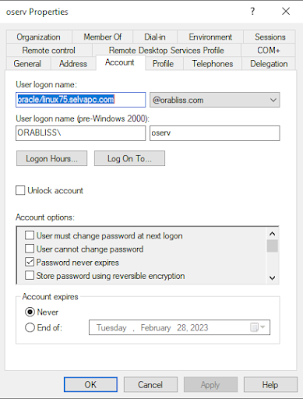
You can now notice in the above command, I'm still using the -mapuser as oserv@orabliss.com which is our SPN. Now the account will look like below.


Notice the User logon name has changed from ORACLE/linux-8.selvapc.com to oracle/linux75.selvapc.com 

Note: Please see the reason for small case usage for "oracle" in the troubleshooting post. 

Now, we are ready for testing. Transfer the keytab file generated to database server linux75.selvapc.com and create the externally authenticated user as usual. Once all is done, we are ready to connect to the database. 
SQL> create user cmuuser identified externally as 'snagulan@ORABLISS.COM';
grant create session to cmuuser;
grant select on v_$database to cmuuser;
User created.

SQL>
Grant succeeded.

SQL>

Grant succeeded.

SQL>
SQL> exit
Disconnected from Oracle Database 12c Enterprise Edition Release 12.2.0.1.0 - 64bit Production
[oracle@linux75 admin]$ okinit snagulan

Kerberos Utilities for Linux: Version 12.2.0.1.0 - Production on 29-JAN-2023 12:53:43

Copyright (c) 1996, 2016 Oracle.  All rights reserved.

Configuration file : /u01/db/122/network/admin/krb5.conf.
Password for snagulan@ORABLISS.COM:
[oracle@linux75 admin]$
[oracle@linux75 admin]$ oklist

Kerberos Utilities for Linux: Version 12.2.0.1.0 - Production on 29-JAN-2023 12:53:50

Copyright (c) 1996, 2016 Oracle.  All rights reserved.

Configuration file : /u01/db/122/network/admin/krb5.conf.
Ticket cache: FILE:/tmp/krb5cc_54321
Default principal: snagulan@ORABLISS.COM

Valid starting     Expires            Service principal
01/29/23 12:53:48  01/29/23 22:53:48  krbtgt/ORABLISS.COM@ORABLISS.COM
        renew until 01/30/23 12:53:44
[oracle@linux75 admin]$ sqlplus /@orclpdb

SQL*Plus: Release 12.2.0.1.0 Production on Sun Jan 29 12:53:58 2023

Copyright (c) 1982, 2016, Oracle.  All rights reserved.


Connected to:
Oracle Database 12c Enterprise Edition Release 12.2.0.1.0 - 64bit Production

SQL> set heading off
select 'DB_NAME (from v$database) : '||name,
       'CONTAINER_NAME            : '||sys_context('USERENV','CON_NAME'),
       'SESSION_USER              : '||sys_context('USERENV','SESSION_USER'),
       'AUTHENTICATED_IDENTITY    : '||sys_context('USERENV','AUTHENTICATED_IDENTITY'),
       'AUTHENTICATION_METHOD     : '||sys_context('USERENV','AUTHENTICATION_METHOD'),
SQL>        'IDENTIFICATION_TYPE       : '||sys_context('USERENV','IDENTIFICATION_TYPE'),
  2    3    4    5    6    7         --'LDAP_SERVER_TYPE          : '||sys_context('USERENV','LDAP_SERVER_TYPE'),
       'ENTERPRISE_IDENTITY       : '||sys_context('USERENV','ENTERPRISE_IDENTITY')
from v$database;  8    9

DB_NAME (from v$database) : ORCL
CONTAINER_NAME            : ORCLPDB
SESSION_USER              : CMUUSER
AUTHENTICATED_IDENTITY    : snagulan@ORABLISS.COM
AUTHENTICATION_METHOD     : KERBEROS
IDENTIFICATION_TYPE       : EXTERNAL
ENTERPRISE_IDENTITY       : snagulan@ORABLISS.COM


SQL> !hostname
linux75.selvapc.com

SQL>
 
Ok, we have successfully tested the kerberos connection from the newly configured database server. What happens to the previously configured database server since we have now change the SPN User Logon name? Does the CMU connection to the server linux-8.selvapc.com still work or does it break after new server configuration? 

Let's test it. 
[oracle@linux-8 ~]$ okinit snagulan

Kerberos Utilities for Linux: Version 19.0.0.0.0 - Production on 29-JAN-2023 23:31:46

Copyright (c) 1996, 2019 Oracle.  All rights reserved.

Configuration file : /oracle/db/db19/network/admin/krb5.conf.
Password for snagulan@ORABLISS.COM:
[oracle@linux-8 ~]$ oklist

Kerberos Utilities for Linux: Version 19.0.0.0.0 - Production on 29-JAN-2023 23:31:53

Copyright (c) 1996, 2019 Oracle.  All rights reserved.

Configuration file : /oracle/db/db19/network/admin/krb5.conf.
Ticket cache: FILE:/tmp/krb5cc_1000
Default principal: snagulan@ORABLISS.COM

Valid starting     Expires            Service principal
01/29/23 23:31:50  01/30/23 09:31:50  krbtgt/ORABLISS.COM@ORABLISS.COM
        renew until 01/30/23 23:31:47
[oracle@linux-8 ~]$ sqlplus /@odb1

SQL*Plus: Release 19.0.0.0.0 - Production on Sun Jan 29 23:32:12 2023
Version 19.10.0.0.0

Copyright (c) 1982, 2019, Oracle.  All rights reserved.

Last Successful login time: Sat Jan 28 2023 23:10:46 +05:30

Connected to:
Oracle Database 19c Enterprise Edition Release 19.0.0.0.0 - Production
Version 19.10.0.0.0

SQL> set heading off
select 'DB_NAME (from v$database) : '||name,
           'CONTAINER_NAME                        : '||sys_context('USERENV','CON_NAME'),
       'SESSION_USER              : '||sys_context('USERENV','SESSION_USER'),
       'AUTHENTICATED_IDENTITY    : '||sys_context('USERENV','AUTHENTICATED_IDENTITY'),
       'AUTHENTICATION_METHOD     : '||sys_context('USERENV','AUTHENTICATION_METHOD'),
       'IDENTIFICATION_TYPE       : '||sys_context('USERENV','IDENTIFICATION_TYPE'),
       'LDAP_SERVER_TYPE          : '||sys_context('USERENV','LDAP_SERVER_TYPE'),
       'ENTERPRISE_IDENTITY       : '||sys_context('USERENV','ENTERPRISE_IDENTITY')
from v$database;SQL>   2    3    4    5    6    7    8    9

DB_NAME (from v$database) : CDB19
CONTAINER_NAME                    : ODB1
SESSION_USER              : SELVA
AUTHENTICATED_IDENTITY    : snagulan@ORABLISS.COM
AUTHENTICATION_METHOD     : KERBEROS_GLOBAL
IDENTIFICATION_TYPE       : GLOBAL EXCLUSIVE
LDAP_SERVER_TYPE          : AD
ENTERPRISE_IDENTITY       : cn=Selvakumar Nagulan,cn=Users,dc=orabliss,dc=com


SQL>
SQL> !hostname
linux-8.selvapc.com

SQL>
 
We can see the CMU connection still works without any issues. This concludes we just need 1 SPN (in our case, oserv) to configure kerberos or CMU connection for multiple oracle database servers. 

Happy CMUing...!!!

Monday, December 12, 2022

Performance slowness due to Spatial component

 We had a complaint from application team that their database is running slow after the quarterly patching. We had patched many databases and only one database is complaining on slowness. The environment is Exacc and the database is a container (running version 19.16) which has multiple PDBs. So patching couldn't be a reason is the initial thought. So we stepped into investigate what is causing the slowness. 

As a first step, we pulled an AWR report for the time frame where they did some DB operations. 


We can see from above that most of the waits are related to Cluster and topping them is gc cr multi block mixedgc cr block 2-way and gc buffer busy acquire

So this means some query is running very frequently accessing 1 or 2 table blocks continuously. We need to figure out which query is running, accessing what table/index and how frequent and what's the elapsed time of the query. These information will get us to move forward. 

Since the waits are related to Cluster, let's see SQL ordered by Cluster Wait Time (Global) section under SQL Statistics


We see 2 queries that contribute to the most cluster waits. Both these are related to spatial component as the queries are as below and they had ~ 53k executions in the report
SELECT /* chk_journal_reg */ rowid FROM "MDSYS"."SDO_TXN_JOURNAL_REG" WHERE sid = :1 AND sdo_txn_idx_id = :2 AND indexptniden = :3 AND operation = :4 AND rid = :5

SELECT /* sel_dist_upd */ ROWID, ....., ins_no, del_no FROM "MDSYS"."SDO_DIST_METADATA_TABLE" WHERE sdo_index_owner = :own AND sdo_index_name = :nam AND sdo_partition_name = :ptn FOR UPDATE

Ok, these 2 queries look simple and not complicated, so what's causing this buffer busy issues? Investigation went in following direction

Check size of tables: They are too small. 

Check the execution plan of the first code with high cluster waits gave us the clue. Though we have primary key defined on all five columns (SID, SDO_TXN_IDX_ID, INDEXPTNIDEN, OPERATION, RID), the query took the path of INDEX STORAGE FAST FULL SCAN which would traverse through all the blocks unnecessarily. The query took around 4 second per execution. 

I hint the query to use the index already available (/*+ index(SDO_TXN_JOURNAL_REG SYS_C0014253) */) - this resulted in a much better plan and execution time. Execution time reduced to milliseconds. Remember this query executed around 53k times which would make a big difference in application performance. While checking for any plan change, I found that the index path was used until the patch was applied and the plan flipped

SQL> select distinct sql_id, plan_hash_value, id, operation, options
  2* from dba_hist_sql_plan where sql_id='fw4q2s9j3bckt' order by plan_hash_value, id;

          SQL_ID    PLAN_HASH_VALUE    ID           OPERATION                   OPTIONS
________________ __________________ _____ ___________________ _________________________
fw4q2s9j3bckt            1765869626     0 SELECT STATEMENT
fw4q2s9j3bckt            1765869626     1 INDEX               STORAGE FAST FULL SCAN
fw4q2s9j3bckt            2134037127     0 SELECT STATEMENT
fw4q2s9j3bckt            2134037127     1 INDEX               UNIQUE SCAN

SQL> 
So, we decided to create sql profile so that the plan stick to plan_hash_value 2134037127 using note Encouraging CBO to Pickup a Better Execution Plan Using the COE XFR SQL Profile Script (Doc ID 1955195.1)

In the mean time, Oracle support note (After Applying the 19.16 DBRU, Scheduler Jobs on Spatial Tables Take a Long Time to Execute (Doc ID 2907800.1)) mentioned a bug related to this same table and query. 

Reason for slowness is 

Running a MV refresh using the DBMS_SCHEDULER package causes spatial to use the SDO_TXN_JOURNAL_REG transaction journal table, instead of the SDO_TXN_JOURNAL_GTT transaction journal table.

So, now the solution is to revert the sql profile created and apply spatial bundle bug fix Patch 34725493 or to apply RU 19.17

Since we already had applied another one off patch for a previous issue with Spatial, we couldn't apply this bug fix patch as it was conflicting with the one off patch. Raised an SR with Oracle to get the merge patch for both the conflicting patches but Oracle couldn't provide any commitment on when the merge patch will be ready.

As we need to get the production database back to normal as soon as we can, we had to roll back the entire 19.16 RU to bring it back to pre patch state (RU 19.15) and then the application verified all the jobs are running without issues. We could also not see any cluster related wait post the patch rollback. We rolled back as 19.17 is yet to be tested in our lower environments before we promote to production.

Interestingly, Oracle maintains a note on all the patches that needs to be applied post RU patch apply under What Is The Latest Spatial Patch Bundle for 12c and Higher Databases? (Doc ID 2514624.1) So every time we apply RU to the database, we need to refer this note and apply the patch that is mentioned for the related RU as well. 

This investigation is not only a trouble shooting experience but also a knowledge gathering experience with Oracle Spatial component regarding the bugs related to Spatial and separate Spatial patch bundle, etc.,. 


Happy Trouble shooting and Patching...!!!